Portrait of a King: Moya’s Portraiture in Spain, and a Royal Commission
Updated: Oct 4
Portraiture as Psychological Revelation
To paint a portrait is, in a sense, to assert an interpretation—to claim that you have understood something about the inner life of the person before you that the camera, or the social protocol of official likeness, might have missed. This interpretive ambition, drawn directly from his years studying Velázquez in the Prado, made José Moya del Pino a sought-after portrait painter in Madrid's intellectual and aristocratic world.
Moya began painting portraits while he was still a student at the Royal Art Academy, and continued to do so for the rest of his life. He portrayed people from a range of social and professional circles, including writers, lawyers, aristocrats, and members of the bourgeoisie. Some notable portraits from his years in Spain:
Doña Ana Teresa Suárez (1909)
Moya's portrait of Doña Ana Teresa Suárez, painted when he was just 19, was described by a scholar as incorporating “abstract connotations more typical of graphic illustration than of naturalistic portraiture,” with a color strategy that is “striking and unusual, and faintly reminiscent of Symbolism”* and a novel combination of the intense crimson-red background with the white of a marabou shawl and the green of the dress.
The reference to graphic illustration is particularly striking given the prominent role that book and magazine illustration would play in Moya’s work during the decade that followed.


José de León Contreras, Count of Cimera (1923)
In the portrait of José de León Contreras, the military attire of the subject decidedly contrasts with the rather non-authoritarian character of his gaze, demonstrating the painter’s ability to see beyond the external appearance of the portrayed. Moya's portraits aimed not at social flattery but at psychological revelation: capturing the essence of a subject that lies beneath the surface, beyond the conventions of dress and social position.
Jacobo Fitz-James Stuart y Falcó, 17th Duke of Berwick and Alba de Tormes (1922)
The Duke of Berwick and Alba was one of the most influential aristocrats in Spain, a diplomat, politician, and enthusiastic art collector. He posed for his portrait in the somewhat ostentatious uniform of knight of the Real Maestranza de Caballeria de Sevilla. This portrait in particular proved instrumental in determining the course of Moya del Pino's future life. Having experienced the artist's's work and heard his idea for copying the complete Velázquez collection in the Prado (which I will discuss in the next post), the Duke introduced the project to King Alfonso XIII, who embraced it enthusiastically.

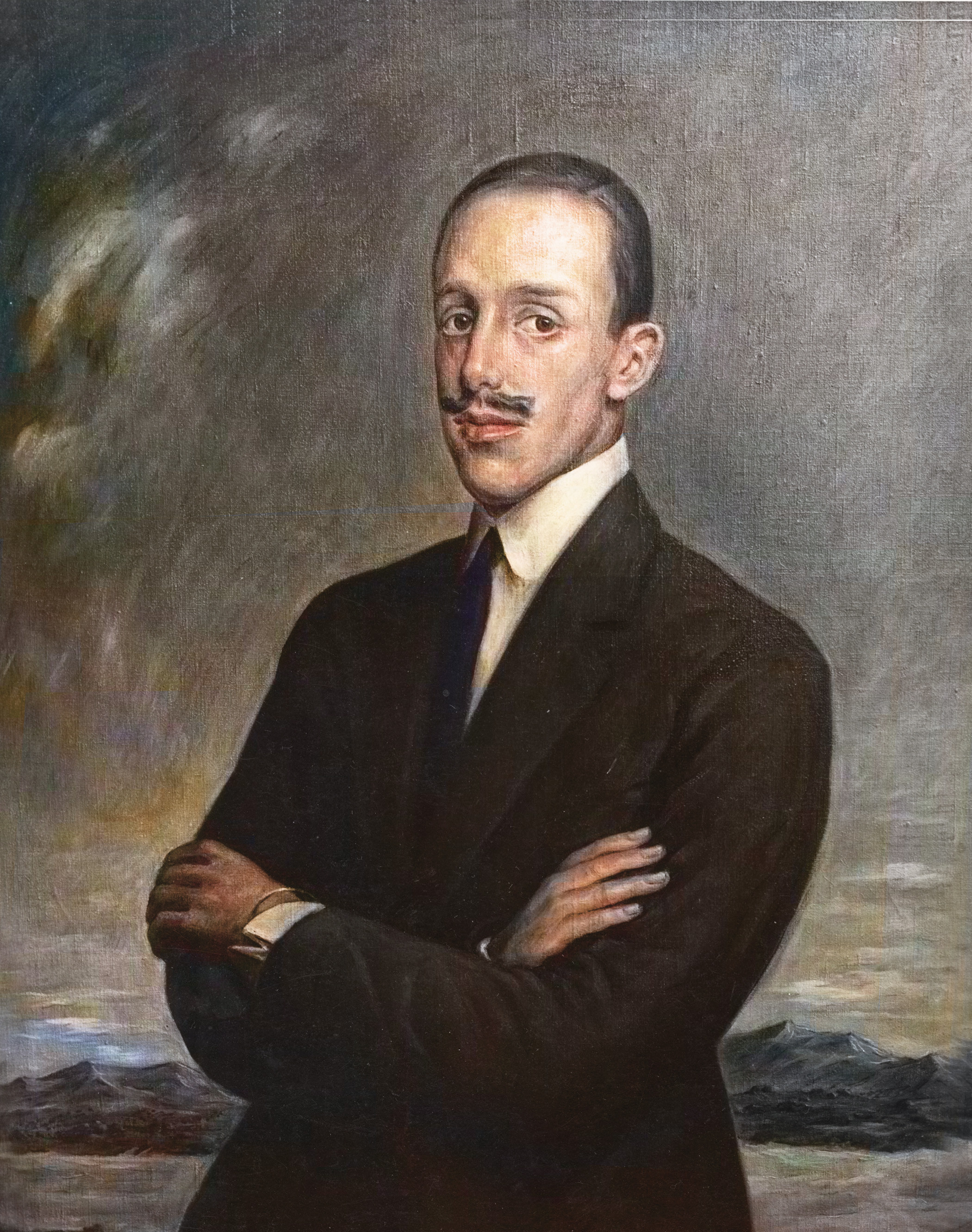
And, in fact, as part of the Velázquez project, even the king himself sat for a portrait.
The King Without His Uniform
By the early 1920s Alfonso XIII had been painted at least fifty times by the leading artists of the era, and always in military or ceremonial dress. Sorolla, Casas, Vázquez Díaz, Romero de Torres, Beltrán—all had presented the King in uniform, in the symbols and costumes that the portrait tradition required. Moya, drawing on his understanding of Velázquez's approach to royal portraiture, proposed military dress: the natural choice, consistent with tradition.
The King, instead, presented himself for the sittings in a jacket and tie.
What happened next became one of Moya's most-told anecdotes.
The finished portrait showed the King as no painter had shown him before: simply as a man, in civilian clothes, looking at the viewer with something approaching relaxation. And as told by Moya, when Alfonso XIII saw it he smiled and quipped: "Thank God, for once I do not feel like the picture on a deck of cards."
It is one of the most human portraits ever made of him. And it was not what the protocol demanded, but what the subject himself wanted, and what the painter's instinct recognized as the truer image.

A Distinctive Voice
The portrait tradition that Moya inhabited in Madrid was one of the most competitive and socially charged markets in Spanish art. The leading portraitists of the era (Sorolla, Romero de Torres, Beltrán) had established clear territories, each distinguished by a recognizable style and a specific social clientele. Entering this market without a clear stylistic identity required either the boldness to establish an identity quickly, or the commercial intelligence to position oneself as offering something the established practitioners did not.
Moya offered both the boldness and the alternative. His crimson background for the Doña Ana Teresa Suárez portrait was a statement: in an environment where dark neutrals were conventional and emotional distance was a professional standard. The intensity of that red made the portrait visible across a room and marked it immediately as the work of a painter with a position. The critic who found it "striking and unusual" was not wrong: he was registering exactly what it was intended to register.
The portrait of King Alfonso XIII, seen in this context, represents the natural culmination of the approach: a painter confident enough in his psychological method to apply it to a subject who had been painted fifty times before, and to produce an image that the subject himself recognized as true. That the King arrived in a jacket and tie suggests that Alfonso XIII had heard or seen enough about the painter's method to understand what it offered. He wanted, just once, to appear simply as a man. Moya gave him that.
“Thank God, for once I do not feel like the picture on a deck of cards.” Moya delighted in recounting the King’s remark for years to family and friends, but the story does capture exactly what the painting had achieved.
The portraits Moya del Pino painted in Spain now lie scattered among private collections, never fully assembled or studied as a body of work. Together they form a gallery of early twentieth-century Spanish intellectual and aristocratic life—one that is waiting, patiently, for the scholarly attention it deserves.
––––––––––––––
To see more portraits painted by José Moya del Pino’s book and magazine illustrations see the Portraits section of the Catalog of Works on this website.
––––––––––––––
* Allen, Jonathan. "Retrato de Dña. Ana Teresa Suárez." Moralia: Revista de Estudios Modernistas, no. 1, Mar. 2002, pp. 20–25.


Comments